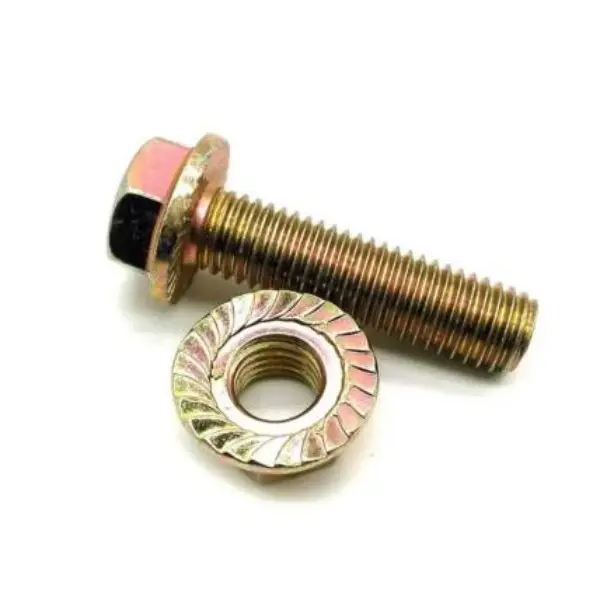
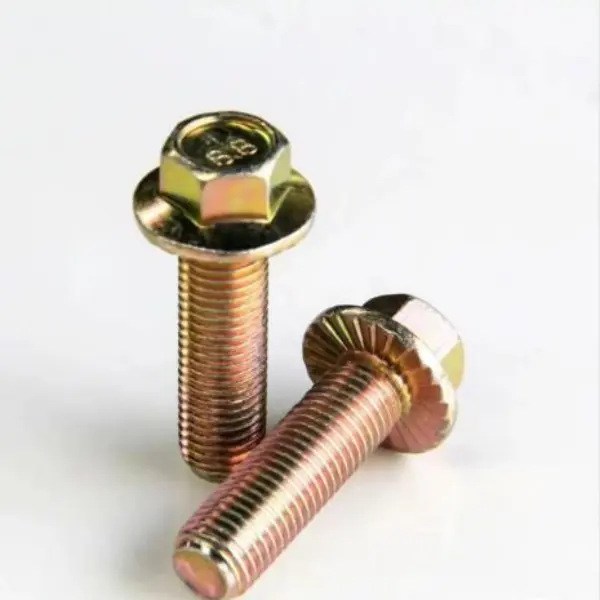
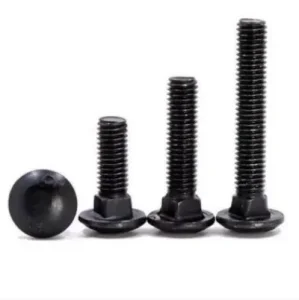
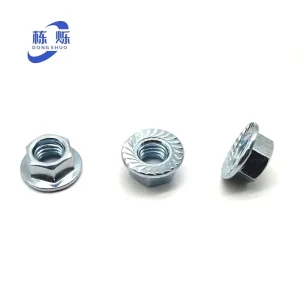
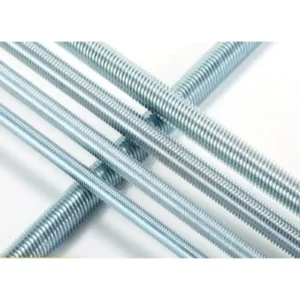
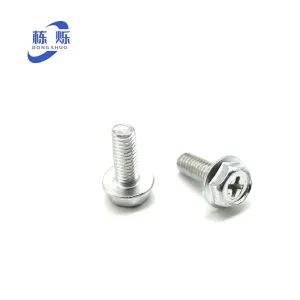
Flange bolt, also known as flange bolt, is a special type of bolt with a flange surface (flange), widely used in situations that require high preload, anti loosening, and sealing.
Structural Characteristics
Flange surface design
There is an integral flange (circular gasket) below the bolt head, which increases the contact area, disperses pressure, and reduces damage to the connection surface.
Hexagonal or twelve pointed head
Commonly designed as a hexagonal head, easy to tighten with standard tools; Some high-strength models use twelve corner heads.
Anti slip tooth pattern
The flange surface of some flange bolts has radial tooth patterns to enhance friction and prevent loosening.
Main Advantages
No need for additional gaskets
The integrated flange replaces traditional gaskets, simplifies installation steps, and reduces costs.
Anti vibration and anti loosening measures
The flange surface increases friction, and the tooth pattern design further prevents bolts from loosening in vibration environments.
Uniform force
The flange disperses the load, protects the surface of the connected parts, and avoids crushing or deformation.
Sealing enhancement
When combined with flange surfaces and soft materials such as rubber gaskets, the sealing performance can be improved.
Key parts such as engines, gearboxes, wheel hubs, machine tools, pumps, and valves benefit from high preload force and vibration resistance.
Material and Surface Treatment
Common Materials
Carbon steel (Grade 4.8, 8.8, 10.9)
Stainless steel (A2-304, A4-316)
Alloy steel (High-strength)
Surface Treatment
Galvanized (Conventional)
Dacromet (High corrosion resistance)
Hot dip galvanizing (Outdoor use)
Phosphating (Wear resistance)
Frequently Asked Questions
What makes a flange bolt different from a standard bolt?
The main difference is the integrated circular flange under the head, which acts as a built-in washer to distribute pressure and protect the connection surface.
Do I need to use separate washers with flange bolts?
No, the integrated flange design replaces traditional gaskets, simplifying installation and reducing the risk of component loss.
How do flange bolts prevent loosening in high-vibration environments?
Some flange bolts feature radial anti-slip tooth patterns on the flange surface, which increases friction and locks the bolt in place against vibration.
Which industries typically use flange bolts?
They are widely used in the automotive industry (engines and wheel hubs), machinery manufacturing, steel structures for buildings/bridges, and rail transit.
What are the most durable surface treatments for outdoor use?
Hot dip galvanizing and Dacromet are recommended for high corrosion resistance and heavy-duty outdoor or marine environments.
Are flange bolts available in high-strength materials?
Yes, they are commonly produced in carbon steel grades like 8.8 and 10.9, as well as alloy steel for high-temperature or extreme-load applications.
 Dongshuo